Why the Universe is Stranger Than It Seems

The universe operates through four fundamental forces: the strong force (binding atomic nuclei), the weak force (governing radioactive decay), electromagnetism (responsible for light, electricity, and magnetism), and gravity. These forces shape everything we observe. But the universe holds deeper mysteries too—the Higgs field permeates all of space and gives particles their mass, while dark matter affects how galaxies rotate and cluster, and dark energy drives the accelerating expansion of the universe.
Of these four forces, gravity stands apart as the strangest. It’s not what most people imagine, not two objects attracting each other like magnets. Instead, gravity is the curvature of spacetime itself. Massive objects create depressions in this fabric, and you’re constantly falling through that curved geometry, like sliding down an endless slope. What stops you from falling through the Earth? A combination of quantum mechanics and electromagnetism. The Pauli exclusion principle, a quantum mechanical rule stating that electrons cannot occupy the same quantum state, creates an exchange interaction that keeps electron clouds from overlapping. This works together with the electromagnetic repulsion between negatively charged electrons. These effects combine to create what we experience as the solidity of matter and keeps us standing on the ground.
Another weird thing about gravity is that it warps time, causing two clocks to tick at different rates depending on how close they are to a massive objects. However this strange force brought order to the early universe’s chaos, gathering scattered matter into galaxies, stars, planets, and ultimately creating the conditions for life.
What captivates me most about the universe is how it defies intuition at every turn. There are particles all around us that barely interact with ordinary matter—we can’t see them, touch them, or feel them. Neutrinos, for instance, pass through your body by the trillions every second without leaving a trace. The vacuum of space isn’t truly empty either. Quantum fields permeate all of space, including the Higgs field. We perceive only a narrow slice of reality using visible light with our eyes to see the world but this is just a tiny fraction of the electromagnetic spectrum. However our instruments, detect infrared, X-rays, radio waves, and more, reveal a universe far richer and stranger than our senses alone could ever show us.
Then there’s the nature of quantum mechanics, which violates every instinct we’ve developed. We cannot know where an electron is within an atom until something interacts with it. Before any measurement or interaction, the electron exists in a superposition of possible locations—we have only probabilities, clouds of likelihood rather than certainty. When a photon hits it, or a detector interacts with it, or any physical interaction occurs, the electron’s position becomes definite. This idea of superposition is strange and weird and not typical in the our world. The quantum world operates by a completely different set of rules.
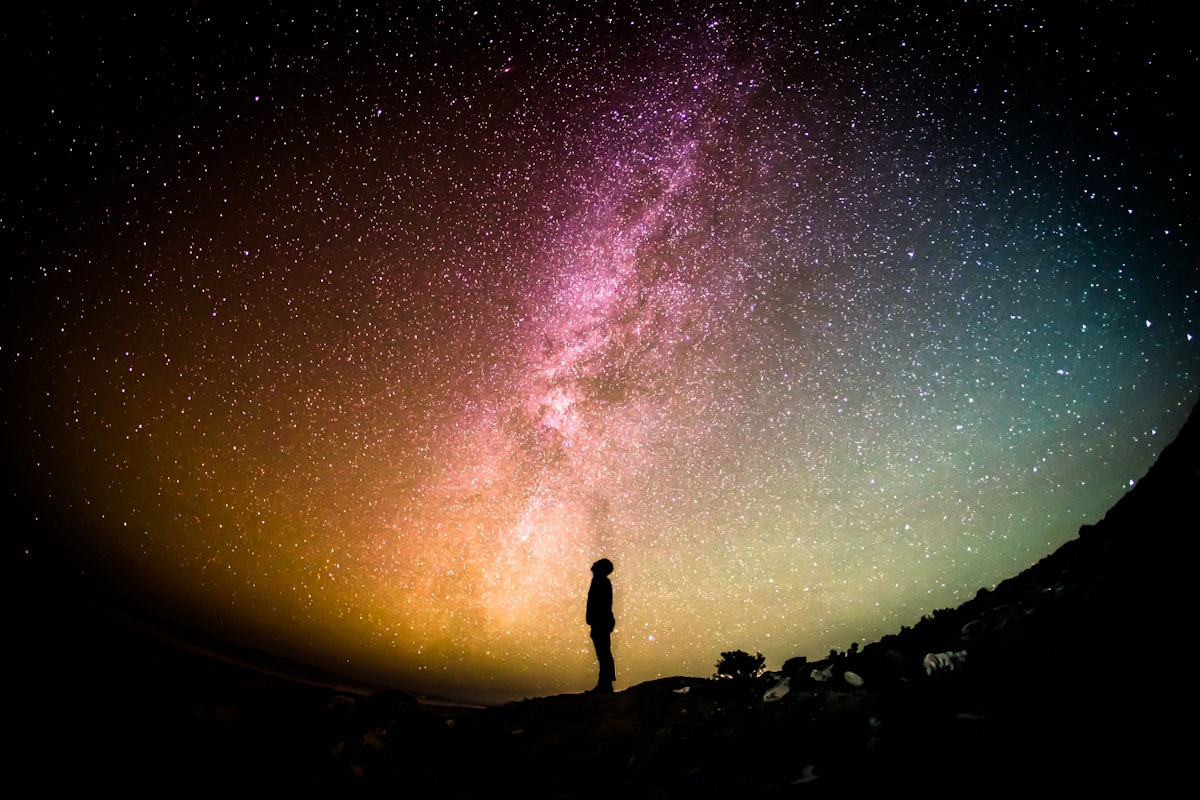
But here’s the most profound thing: all of this—these forces, fields, and quantum phenomena—somehow assembles into stars, planets, and eventually us. Into trillions of synaptic connections capable of thought and wonder. The universe becomes conscious of itself and begins asking questions about its own nature. It’s like waking with complete amnesia, trying to piece together who you are from fragments of information. The universe examining itself.
Perhaps somewhere else in the cosmos, other conscious beings have figured it all out. But we’re still at the beginning, and there’s something beautiful about that.


